Dill
NameDill
Scientific NameAnethum graveolens
Common NamesDill, Dill Weed, Dill Seed
Plant FamilyApiaceae
Natural HabitatNative to southwestern Asia and southern Europe, Dill thrives in temperate climates. It is commonly cultivated in gardens and can be found growing wild in fields and disturbed areas with well-drained soil and full sun.
Parts Usedleaf,seed
Medicinal Actionscarminative, antimicrobial, antioxidant, nervine, sedative
Traditional UsesTraditionally, dill has been used to aid digestion, relieve flatulence, and soothe colic in infants. It is also employed as a mild nervine to promote relaxation and sleep, and to stimulate milk production in nursing mothers. The seeds are often chewed for bad breath.
Active ConstituentsCarvone, Limonene, Anethofuran, Dillapiole, Flavonoids
Preparation Methodsinfusion, decoction, tincture, essential oil, powder
Contraindications & WarningsGenerally safe, but large doses of dill essential oil can be toxic and should be avoided, especially during pregnancy. Individuals with allergies to plants in the Apiaceae family (e.g., celery, carrot) may experience cross-reactivity. May cause photosensitivity in sensitive individuals.
Cultivation NotesDill is an easy-to-grow annual herb that prefers full sun and well-drained soil. It is best direct-sown after the last frost and can be planted in succession every few weeks for a continuous harvest of leaves and seeds.
Raritycommon
Description
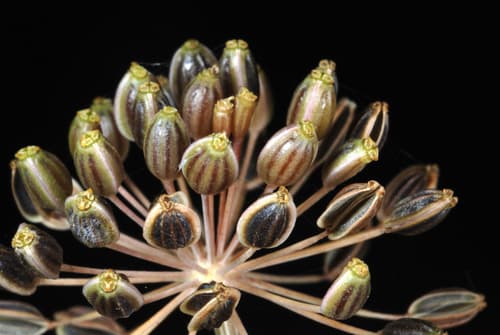
Dill is an annual herb characterized by its feathery, aromatic leaves and umbrella-shaped flower heads that produce flattened, oval, ribbed seeds. The image displays the mature or maturing seeds, which are typically light brown with darker longitudinal ridges.