Bush Morning-glory
NameBush Morning-glory
Scientific NameIpomoea leptophylla
Common NamesBush Morning-glory, Bush Morning Glory, Bigroot Morning Glory
Plant FamilyConvolvulaceae
Natural HabitatNative to central North America, found in sandy soils, prairies, plains, and open woodlands, thriving in dry, well-drained areas.
Parts Usedroot
Medicinal Actionsantioxidant
Traditional UsesThe large, starchy root was a significant food source for various Native American tribes (e.g., Pawnee, Comanche, Kiowa, Cheyenne), eaten raw, roasted, or boiled. It was also occasionally used as a bulk laxative or for general debility, though its primary role was nutritional.
Active ConstituentsStarch, Resin glycosides
Preparation Methodsdecoction, powder
Contraindications & WarningsGenerally considered safe as a food source. However, like many Ipomoea species, some parts might contain resin glycosides which can be purgative in large doses; caution is advised for individuals with sensitive digestive systems or during pregnancy.
Cultivation NotesPrefers full sun and well-drained, sandy or gravelly soils. It is highly drought-tolerant once established and can be propagated by seed or root division.
Raritycommon
Description
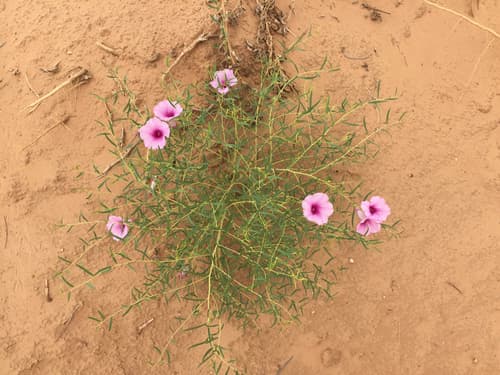
A perennial plant forming a bushy mound with numerous slender stems and narrow, linear leaves. It produces showy, funnel-shaped flowers that are typically pink to purplish-pink, and is characterized by a very large, deep taproot.