Houseleek
NameHouseleek
Scientific NameSempervivum tectorum
Common NamesHouseleek, Common Houseleek, Hen-and-Chicks, Jupiter's Beard, St. Patrick's Cabbage
Plant FamilyCrassulaceae
Natural HabitatNative to mountainous regions of southern and central Europe, Houseleek thrives in dry, sunny conditions. It is commonly found growing on rocks, walls, roofs, and in rocky crevices, preferring well-drained, poor soils.
Parts Usedleaf,whole_plant
Medicinal Actionsanti-inflammatory, antimicrobial, astringent, demulcent
Traditional UsesTraditionally, Houseleek has been used topically for its cooling and soothing properties. The fresh juice or crushed leaves are applied as a poultice to treat burns, insect stings, warts, corns, minor cuts, and various skin irritations, including eczema and shingles. It is also used to reduce inflammation and pain.
Active ConstituentsFlavonoids, tannins, mucilage, malic acid, isocitric acid
Preparation Methodspoultice, infusion, salve
Contraindications & WarningsGenerally considered safe for external use. Internal use is not recommended due to limited research on safety and potential gastrointestinal upset. Pregnant or breastfeeding women and young children should avoid internal use.
Cultivation NotesHouseleek is very easy to cultivate, preferring full sun to partial shade and extremely well-drained soil. It is drought-tolerant and hardy, making it suitable for rock gardens, containers, and green roofs. Propagates readily from offsets.
Raritycommon
Description
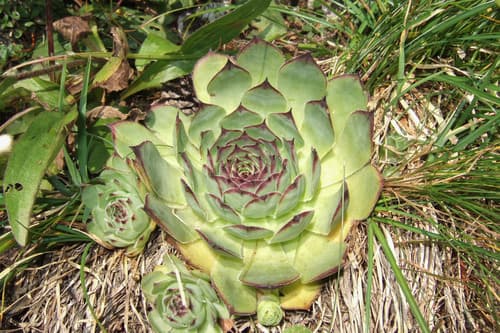
A succulent perennial forming dense rosettes of fleshy, pointed leaves, typically green with reddish-brown tips that often turn purple in strong sun. It produces numerous offsets, known as 'chicks', around the main rosette, giving rise to its common name 'Hen-and-Chicks'.