Senna
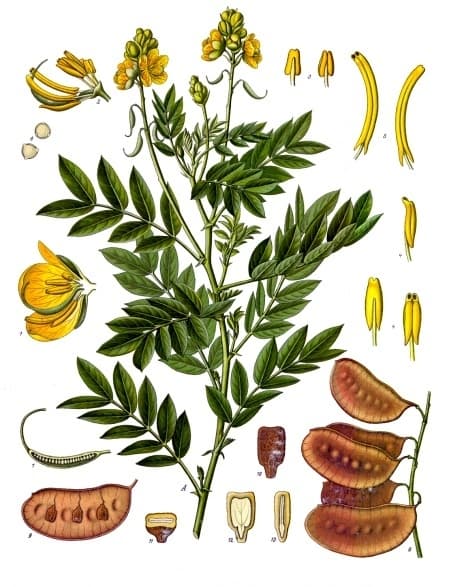
Image: Franz Eugen Köhler, Köhler's Medizinal-Pflanzen (Public domain)
NameSenna
Scientific NameSenna alexandrina
Common NamesAlexandrian Senna, Indian Senna, True Senna, Khartoum Senna
Plant FamilyFabaceae
Natural HabitatNative to tropical and subtropical regions of Africa and Asia, particularly found in arid and semi-arid areas of North Africa, the Arabian Peninsula, and India. It thrives in dry, sandy, and rocky soils.
Parts Usedleaf,fruit
Traditional UsesTraditionally, Senna is widely used as a powerful stimulant laxative to relieve constipation. It is effective for short-term treatment of occasional constipation and for bowel preparation before medical procedures.
Active ConstituentsSennosides A, Sennosides B, Sennosides C, Sennosides D, Anthraquinone glycosides
Preparation Methodsinfusion, powder
Contraindications & WarningsContraindicated in cases of abdominal pain of unknown origin, intestinal obstruction, inflammatory bowel disease (e.g., Crohn's disease, ulcerative colitis), appendicitis, and dehydration. Not recommended for prolonged use, during pregnancy, breastfeeding, or for children under 12 years old.
Cultivation NotesSenna alexandrina prefers warm, sunny climates and well-drained, sandy or loamy soils. It is drought-tolerant once established and can be propagated from seeds. Requires minimal watering and is often grown as an annual or perennial in suitable zones.
Raritycommon
Description
Senna alexandrina is a small shrub characterized by its pinnate leaves with multiple leaflets, bright yellow flowers arranged in terminal racemes, and distinctive flat, oblong, papery pods containing several seeds. The plant typically grows to about 1 meter in height, displaying a bushy habit.