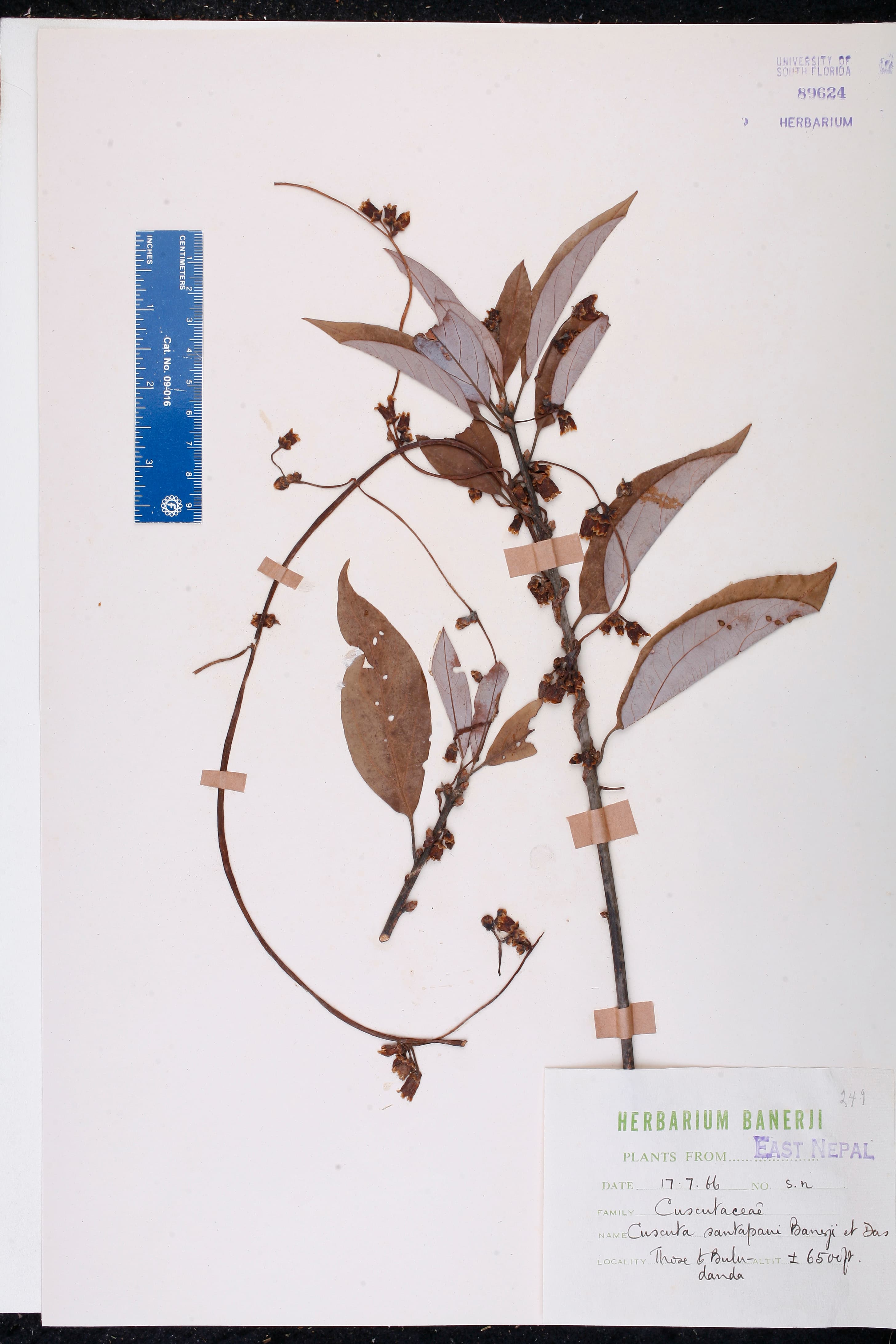
Cuscuta santapaui
Image: unknown (cc-by-nc)
NameCuscuta santapaui
Scientific NameCuscuta santapaui Banerji & S.Das
Common NamesDodder, Love Vine, Strangleweed
Plant FamilyCuscutaceae
Natural HabitatObligate parasite found on various host plants in diverse habitats, including disturbed areas, fields, and roadsides. This specimen was collected in East Nepal at approximately 6500 feet altitude.
Parts Usedwhole_plant,seed
Medicinal Actionsadaptogen, anti-inflammatory, antioxidant, diuretic, nervine
Traditional UsesTraditionally, Cuscuta species are used in various systems of medicine for liver and kidney disorders, to improve vision, strengthen bones, and as an aphrodisiac. It is also employed as a general tonic and for certain skin conditions.
Active ConstituentsFlavonoids, Lignans, Polysaccharides, Coumarins, Alkaloids
Preparation Methodsinfusion, decoction, powder, tincture
Contraindications & WarningsContraindicated in pregnancy, lactation, and individuals with spleen deficiency or excess heat conditions. May interact with certain medications due to its diuretic or potential hormonal effects. Proper identification is crucial due to its parasitic nature.
Cultivation NotesAs an obligate parasitic plant, Cuscuta santapaui requires a host plant for growth and survival. It is typically not cultivated intentionally but rather harvested from the wild or from host plants. Propagation occurs primarily via seeds.
Rarityuncommon
Description
Cuscuta santapaui is a parasitic plant characterized by its slender, leafless, yellowish stems that twine around host plants. It lacks chlorophyll and obtains nutrients via haustoria, with small, clustered flowers borne along its stems.