Butcher's Broom
NameButcher's Broom
Scientific NameRuscus aculeatus
Common NamesButcher's Broom, Box Holly, Knee Holly
Plant FamilyAsparagaceae
Natural HabitatNative to Western and Southern Europe, Northwest Africa, and Southwest Asia, it thrives in woodlands, scrubland, hedges, and rocky areas. It prefers dry, shady conditions and well-drained soil.
Parts Usedroot
Medicinal Actionsastringent, anti-inflammatory, diuretic
Traditional UsesTraditionally, Butcher's Broom has been used to support circulatory health, particularly for conditions like chronic venous insufficiency, varicose veins, and hemorrhoids. It is also employed to reduce edema and swelling in the legs and ankles due to its venotonic properties.
Active ConstituentsRuscogenins
Preparation Methodsdecoction, tincture, powder, salve
Contraindications & WarningsNot recommended for individuals with high blood pressure or kidney disease without medical supervision. May interact with alpha-adrenergic blocking agents. Pregnant or breastfeeding women should avoid use.
Cultivation NotesA hardy, drought-tolerant evergreen shrub that prefers partial to full shade and well-drained soil. It is slow-growing but very low maintenance once established, making it suitable for difficult shady spots.
Raritycommon
Description
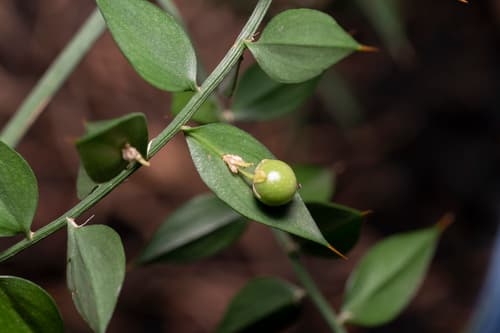
Butcher's Broom is an evergreen shrub characterized by stiff, flattened, leaf-like stems called cladodes, each ending in a sharp spine. Small, inconspicuous greenish flowers emerge from the center of these cladodes, developing into bright red berries (green when immature) in autumn and winter.