Bistort
NameBistort
Scientific NameBistorta officinalis
Common NamesCommon Bistort, European Bistort, Snakeweed, Adderwort, Easter-Ledges
Plant FamilyPolygonaceae
Natural HabitatPrefers damp meadows, moist grasslands, stream banks, and open woodlands, often found in nutrient-rich, heavy soils across temperate regions of Europe and Asia.
Parts Usedroot,leaf
Medicinal Actionsastringent, anti-inflammatory, antimicrobial, antioxidant
Traditional UsesTraditionally, the rhizome of Bistort has been used internally to treat diarrhea, dysentery, peptic ulcers, and excessive menstrual bleeding due to its potent astringent properties. Externally, it was applied as a gargle for sore throats, mouth ulcers, and gingivitis, and as a wash or poultice for wounds, hemorrhoids, and skin inflammations.
Active ConstituentsTannins (gallotannins, catechins), Flavonoids, Gallic acid, Starch
Preparation Methodsdecoction, infusion, powder, poultice, tincture
Contraindications & WarningsHigh tannin content may cause stomach upset or constipation in sensitive individuals or with prolonged use. Avoid during pregnancy and breastfeeding due to insufficient safety data. May interfere with the absorption of medications if taken concurrently.
Cultivation NotesGrows best in full sun to partial shade in moist, well-drained to wet, humus-rich soil. It is a robust and hardy plant that can spread readily by its creeping rhizomes, making it suitable for naturalizing in damp areas.
Raritycommon
Description
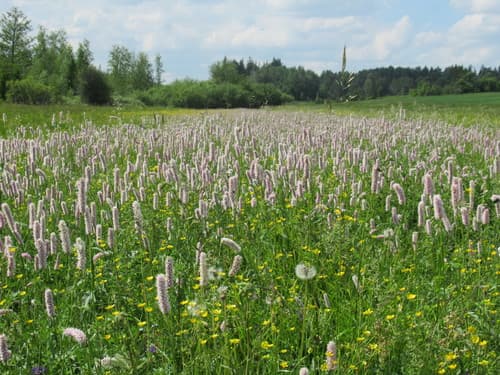
A perennial herbaceous plant characterized by its unbranched stems, typically growing 30-80 cm tall, topped with a single dense, cylindrical spike of small, pale pink to rose-colored flowers. It features large, oblong-lanceolate basal leaves with long petioles and smaller, sessile stem leaves.