Silver Ponyfoot
NameSilver Ponyfoot
Scientific NameDichondra nivea
Common NamesSilver Ponyfoot, Silver Falls Dichondra
Plant FamilyConvolvulaceae
Natural HabitatNative to arid and semi-arid regions, particularly in the southwestern United States and Mexico, it thrives in rocky areas, grasslands, and open woodlands. It prefers well-drained soils and can tolerate full sun to partial shade, often found in dry, exposed conditions.
Parts Used
Traditional UsesWhile some species within the Dichondra genus (e.g., Dichondra repens) have minor traditional uses in certain cultures (such as for wound healing or as a diuretic), Dichondra nivea itself is not widely documented in traditional ethnobotanical or herbal medicine for specific medicinal purposes. Its primary use is ornamental as a groundcover.
Contraindications & WarningsThere are no widely documented medicinal uses or associated contraindications for Dichondra nivea in herbal medicine. It is primarily cultivated as an ornamental plant and is not typically used internally or externally for therapeutic purposes.
Cultivation NotesThis plant is commonly grown as an ornamental groundcover, lawn substitute, or in containers, especially in xeriscaping. It prefers full sun to partial shade, well-drained soil, and is drought-tolerant once established, requiring minimal watering. It is generally low-maintenance and can spread vigorously.
Raritycommon
Description
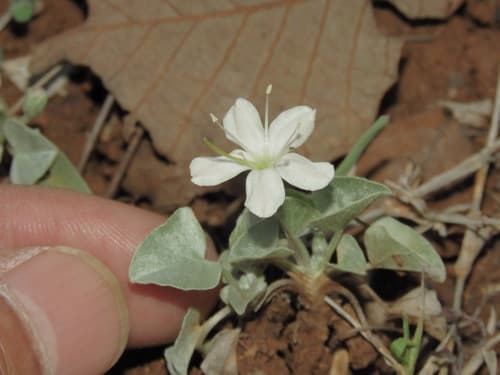
Dichondra nivea is a low-growing, prostrate perennial herb characterized by its small, kidney-shaped to orbicular leaves densely covered with silvery hairs, giving them a distinctive metallic sheen. It produces inconspicuous white to greenish-white, star-shaped flowers with five petals, typically emerging from the leaf axils. This plant forms a dense, mat-like groundcover.