Palmer's Mock Orange
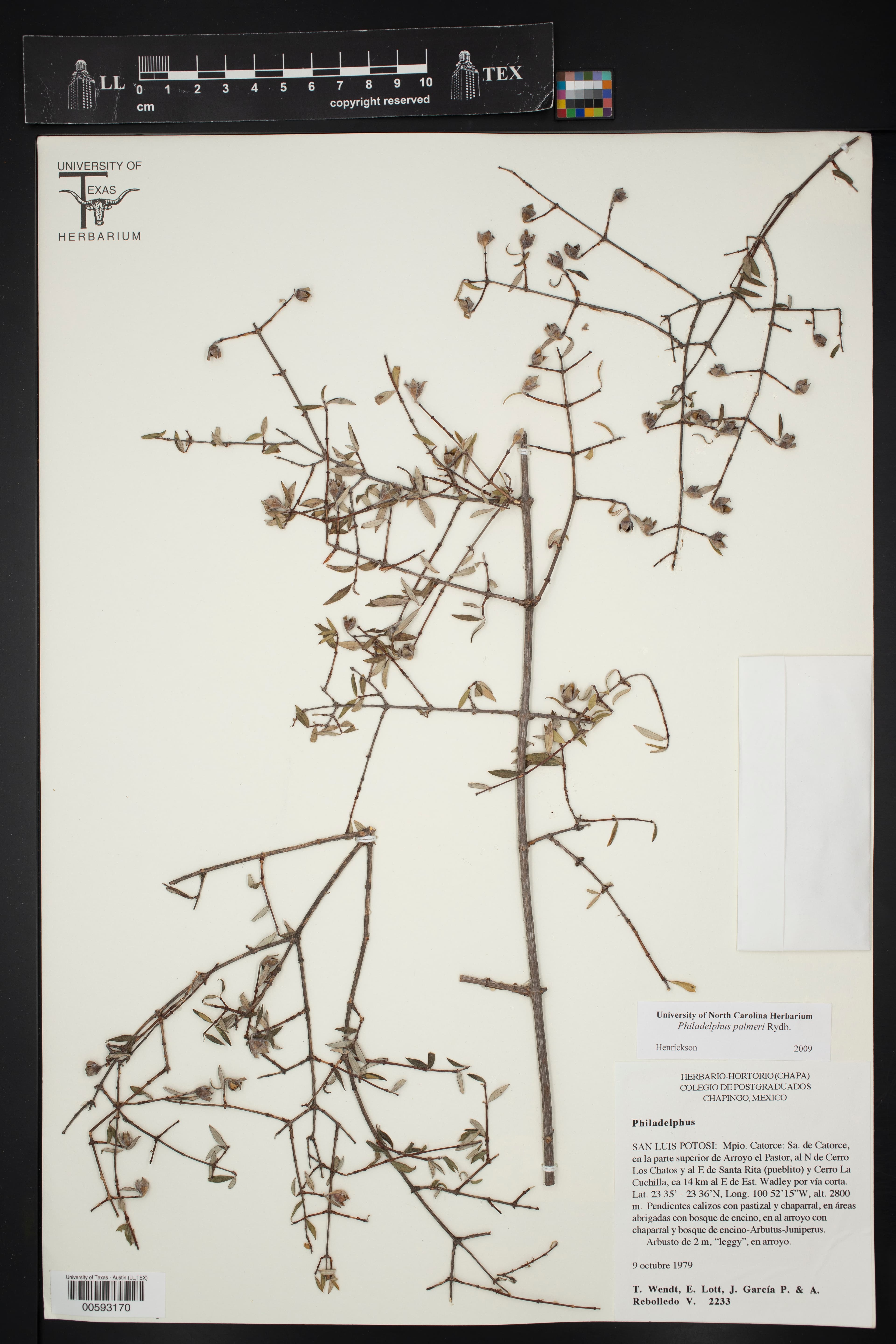
Image: Tom Wendt|Emily J. Lott|Jose Garcia Perez|A. Rebolledo V (cc0)
NamePalmer's Mock Orange
Scientific NamePhiladelphus palmeri Rydb.
Common NamesPalmer's Mock Orange, Mock Orange
Plant FamilyHydrangeaceae
Natural HabitatThis species is found in high-altitude (around 2800 m) calcareous slopes in San Luis Potosí, Mexico. It thrives in areas with grassland and chaparral, often in sheltered locations with oak, Arbutus, and Juniperus forests, particularly along arroyos (dry streambeds).
Parts Used
Traditional UsesThere are no widely documented traditional medicinal uses specifically for Philadelphus palmeri. While some related Philadelphus species have very mild historical uses (e.g., as a diaphoretic), these are not well-supported or commonly practiced, and no specific medicinal applications are attributed to P. palmeri in ethnobotanical literature.
Contraindications & WarningsDue to the lack of documented medicinal uses, specific contraindications for Philadelphus palmeri are not known. It is primarily considered an ornamental plant.
Cultivation NotesPalmer's Mock Orange is a hardy shrub that prefers well-drained soil and can tolerate full sun to partial shade. Once established, it is relatively drought-tolerant, making it suitable for xeriscaping in its native range. It can be propagated by seed or cuttings.
Rarityuncommon
Description
Philadelphus palmeri is a deciduous shrub typically growing up to 2 meters tall, characterized by slender, often 'leggy' woody stems. It bears small, simple, opposite leaves and produces fragrant white flowers, which develop into dry capsules.