Butcher's Broom
NameButcher's Broom
Scientific NameRuscus aculeatus
Common NamesButcher's Broom, Knee Holly, Box Holly, Sweet Broom
Plant FamilyAsparagaceae
Natural HabitatNative to Western and Southern Europe, Northwest Africa, and Southwest Asia, it thrives in woodlands, scrublands, hedges, and rocky areas, often preferring dry, shady conditions.
Parts Usedroot
Medicinal Actionsanti-inflammatory, astringent
Traditional UsesTraditionally, Butcher's Broom has been used to treat conditions related to venous insufficiency, such as varicose veins, hemorrhoids, and edema in the legs. It was also historically used as a diuretic and laxative, and its stiff branches were used to make brooms.
Active ConstituentsRuscogenins, Flavonoids, Sterols
Preparation Methodsdecoction, tincture, powder, salve
Contraindications & WarningsIndividuals with high blood pressure should use with caution due to potential vasoconstrictive effects. Not recommended during pregnancy or breastfeeding. May interact with alpha-adrenergic blocking drugs and diuretics.
Cultivation NotesThis hardy plant prefers partial to full shade and well-drained soil. It is drought-tolerant once established and can be slow-growing. It is often used in dry shade gardens.
Raritycommon
Description
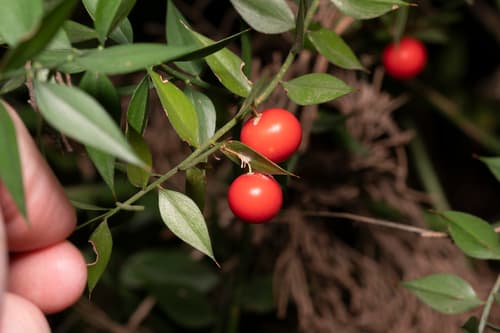
Butcher's Broom is a low-growing evergreen shrub characterized by stiff, flattened, leaf-like stems called cladodes, which are sharply pointed. It produces small, greenish-white flowers that develop into bright red berries, typically maturing in autumn and winter.